Cedar is not a single timber species but a term applied to several botanically distinct trees whose wood shares aromatic properties and certain structural characteristics. In the context of furniture and storage, the two most commonly encountered types are Eastern red cedar (Juniperus virginiana), widely used for chest and wardrobe lining in North America and exported globally, and Atlantic cedar (Cedrus atlantica), native to the Atlas Mountains of North Africa and frequently used in European furniture trade.
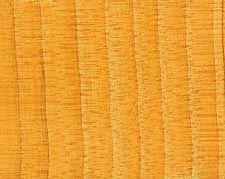
Cross-section of Cedrus wood showing the distinct grain and heartwood zone. Source: Wikimedia Commons (CC BY-SA).
Grain Structure and Appearance
Cedar heartwood is typically reddish-brown to pale rose in colour, with the sapwood — the outer layer near the bark — appearing notably lighter, often cream or pale yellow. The contrast between heartwood and sapwood is one of cedar's distinctive visual features and is frequently displayed intentionally in decorative furniture panels.
The grain is generally straight to slightly irregular, with a fine to medium texture. Growth rings are visible but not as pronounced as in oak or ash. When freshly cut or sanded, the surface reflects light evenly, giving it a smooth, almost silky appearance despite having no applied finish.
Cedar does not produce the dramatic figure patterns found in some hardwoods. Its visual character comes primarily from colour contrast and the natural warmth of the wood's tone rather than complex figure.
Density and Weight
Eastern red cedar has a relatively low density compared to most furniture hardwoods. Published values in USDA forestry literature place air-dry density of Juniperus virginiana at approximately 530 kg/m³, making it substantially lighter than oak (around 700–750 kg/m³) and closer to pine in weight. Atlantic cedar (Cedrus atlantica) falls in a similar range.
This low density is practical for storage furniture. Cedar chests and blanket boxes are easy to move, and cedar-lined drawers add minimal weight to a carcase constructed from heavier timber. The trade-off is reduced hardness — cedar dents and scratches more readily than dense hardwoods, which affects its suitability for surfaces subject to impact.
Natural Oils and Preservative Properties
The heartwood's characteristic scent comes from volatile terpenoid compounds, principally cedrol (a sesquiterpene alcohol) and cedrene. These are produced naturally by the tree as a defence mechanism against insects and fungal decay. In practical terms, they give freshly milled or sanded cedar a measurable deterrent effect on common textile pests.
These oils are concentrated in the heartwood. Sapwood contains far fewer volatile compounds and provides little aromatic protection. When specifying cedar for insect-deterrent applications, the proportion of heartwood in any given board or product is directly relevant to its effectiveness.
Dimensional Stability Indoors
Cedar has a relatively low volumetric shrinkage — the USDA Wood Handbook records radial shrinkage of approximately 3.1% and tangential shrinkage of approximately 4.7% for Eastern red cedar from green to oven-dry state. These figures are among the lower end for North American softwoods.
In practice, indoor furniture in a climate-controlled environment undergoes only partial shrinkage and swelling across seasonal humidity cycles. Cedar furniture in Polish interiors — where central heating reduces winter humidity — typically shows minor seasonal movement but rarely enough to cause joint failure in well-constructed pieces.
Note on Sapwood vs Heartwood
Commercial cedar products — particularly thin planks sold for drawer lining — sometimes include a substantial proportion of sapwood. Sapwood does not carry the aromatic compounds responsible for moth deterrence. When purchasing cedar lining boards, heartwood content (indicated by the reddish-brown colouration) is a more reliable indicator of function than label claims alone.
Working Properties
Cedar is easy to cut, plane and sand with hand tools and power equipment. It works cleanly along the grain but can produce a slightly splintery surface when cut against the grain. Sharp tools are recommended for clean results.
The wood takes glue bonds reliably, though its oily surface may require a light wipe with a solvent such as acetone before gluing to ensure adequate adhesion. Nailing and screwing are straightforward, though pilot holes prevent splitting near edges in thinner stock.
Surface finishing is optional for storage applications — unfinished cedar maintains its aromatic function best. If a sealed surface is required, oil-based finishes are compatible, though any film-forming finish reduces the rate at which volatile compounds are released from the surface.
Durability in Indoor Use
Cedar is classified as durable to moderately durable in contact with the ground according to European standard EN 350. For indoor, above-ground furniture applications, this classification is largely academic — the relevant factors are resistance to surface damage and the longevity of the aromatic properties rather than biological decay resistance.
In indoor use, cedar furniture is long-lived. Museum collections and conservation surveys in Poland and elsewhere document cedar-lined chests in functional condition after many decades of continuous use, provided they have not been stored in damp conditions.
References
- USDA Forest Service. Wood Handbook: Wood as an Engineering Material. FPL-GTR-190. 2010.
- Panshin, A.J., de Zeeuw, C. Textbook of Wood Technology. 4th ed. McGraw-Hill, 1980.
- EN 350:2016. Durability of wood and wood-based products. European Committee for Standardization.